
Kidney Function Test Results Explained
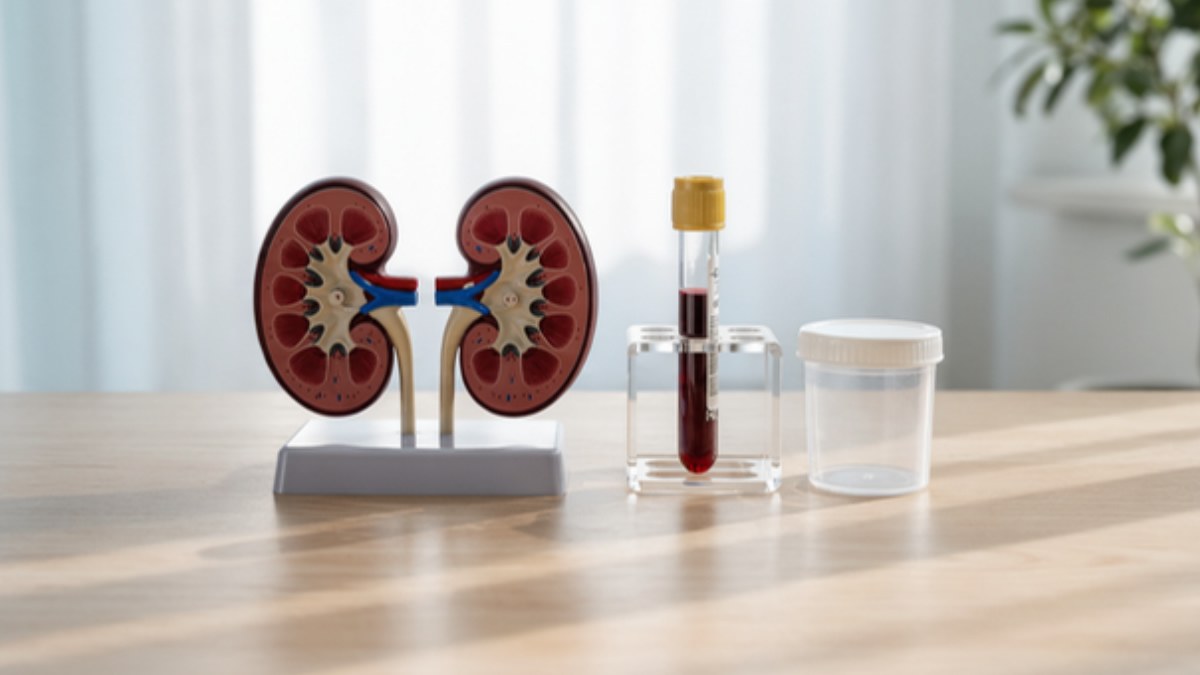
A kidney function test is a blood test, often paired with a urine test, that shows how well your kidneys filter waste. Two key results are your eGFR, worked out from a blood test, and your urine albumin-to-creatinine ratio (ACR). One abnormal result does not prove long-term kidney disease. But do not ignore it, because it can also be the first sign of a sudden kidney problem.
This guide explains what each result means, which results and symptoms need a doctor quickly, and how to get tested at home in the UAE. It is for adults who are not pregnant. Pregnant women, children, and people with a kidney transplant or on dialysis need different advice, given below.
Kidney function results at a glance
- Two tests, not one: the international KDIGO 2024 guideline says to test people at risk with both eGFR (blood) and albumin (urine).
- eGFR of 60 to 89 is not chronic kidney disease unless there is other evidence of kidney damage.
- eGFR below 60 for at least 3 months meets the definition of chronic kidney disease. Do not wait 3 months: show a new result below 60 to a doctor within days.
- Go to an emergency department if your eGFR is below 15 and no kidney team is managing it, or your potassium is 6.5 mmol/L or more (or 5.5 or more and you feel unwell). Go too if you are confused, very drowsy, struggling to breathe or have chest pain.
- See a doctor the same day if your eGFR is 15 to 29 and no doctor is already following it, your creatinine has risen sharply (see the table), or your potassium is 6.0 to 6.4. Contact a doctor the same day if your creatinine is high and you have no eGFR.
- Our AED 199 blood panel does not list eGFR or a urine test.
When kidney results need urgent help
Acute kidney injury is when something suddenly stops your kidneys working as well as they should. The NHS says it can be very serious for some people, and that many people have no symptoms, especially if it is mild. Where the sources give no exact timing, we chose the more cautious step. If an emergency or same-day sign or result fits you, do not book a home test or wait for a repeat result first. If you cannot reach a doctor that day, go to a 24-hour clinic or an emergency department. Do not wait if you are getting worse.
Emergency signs, even with no result
Call an ambulance (998 in the UAE) or go to an emergency department, without driving yourself, if you have any of these:
- confusion, or being very sleepy or hard to wake;
- difficulty breathing, or very quick breaths;
- chest pain, collapse, fainting or a fit (seizure);
- a new slow, weak or irregular pulse, or palpitations with a high potassium result;
- cold, clammy skin, or blue, grey, pale or blotchy skin, lips or tongue (on brown or black skin, check the palms and soles);
- vomiting blood (which can look red, brown, black or like coffee grounds), or heavy or non-stop bleeding from your bottom.
Signs that need a doctor the same day
See a doctor the same day if you have one or more of these signs of acute kidney injury (NHS) and it is new, especially after illness, dehydration or a new medicine:
- peeing a lot less than usual;
- feeling very thirsty even after drinking, or feeling or being sick;
- swollen feet or legs;
- unusual tiredness or dizziness;
- feeling breathless when you lie down.
Also see a doctor the same day for any of these:
- You cannot pee at all. Go to an emergency department if it is painful.
- You have, or might have, blood in your urine, even a small amount.
- Black or dark red stools, or bloody diarrhoea.
- Severe pain in your side, back or groin, or pain there with a high temperature or shivering.
- Vomiting, diarrhoea or a high fever when you cannot drink enough, a fast heartbeat, or dizziness on standing that does not go away.
What to do with your kidney result
If more than one line fits, follow the most urgent. Check that the unit on your report matches.
| Your result | What to do |
|---|---|
| eGFR below 15, unless a kidney team is already managing it | Emergency department now |
| Potassium 6.5 mmol/L or more | Emergency department now |
| Potassium 5.5 to 6.4 mmol/L, and you feel unwell (for example palpitations, muscle weakness, numbness, feeling or being sick), pass much less urine, or have an eGFR or creatinine result marked same day below | Emergency department now |
| Any result your report marks critical or urgent | Emergency department now, unless a doctor who knows the result tells you otherwise |
| eGFR 15 to 29 and no doctor is already following it, or it has fallen by more than a fifth to below 30 | See a doctor the same day |
| Creatinine 1.5 times an earlier result or more, or up by 26 micromol/L (0.3 mg/dL) or more within 48 hours | See a doctor the same day |
| Creatinine above the range on your report and no eGFR, unless a doctor already knows about this level and is following it | Contact a doctor the same day and ask them to work out your eGFR. Then use the eGFR lines |
| Potassium 6.0 to 6.4 mmol/L, if the emergency line above does not fit | See a doctor the same day; it needs repeating within a day |
| Potassium below the range, or sodium, calcium or phosphorus outside the range | Contact a doctor the same day and read out the number. Emergency department if you have muscle weakness, a fit, confusion or an irregular heartbeat |
| Potassium above the range and up to 5.9 mmol/L, if the emergency line above does not fit | Contact a doctor promptly; at 5.5 to 5.9 it needs repeating within 3 days |
| eGFR 30 to 59 and no doctor is already following it, or any eGFR that has fallen by more than a fifth | See a doctor within days. NICE asks for a first result below 60 to be repeated within 2 weeks |
| ACR above 30 mg/mmol (300 mg/g), or twice an earlier result or more, unless your doctor already knows about it | See a doctor within days; the same day if you also have blood in your urine |
| ACR 3 to 30 mg/mmol (30 to 300 mg/g), if your doctor does not already know about it | Make an appointment; the doctor will usually ask for an early-morning sample to confirm it |
| Any other kidney result outside the range on your report, if it is new or has changed | Show it to a doctor within days. For an eGFR of 60 to 89, see the eGFR section |
Where these come from: MedlinePlus says a GFR below 15 needs immediate medical attention. The potassium levels and repeat times are from the UK Kidney Association's July 2026 guideline, which suggests hospital assessment at 5.5 to 6.4 for people who are acutely unwell, particularly with acute kidney injury. The creatinine rises are the ones the UK's NICE guideline uses to detect acute kidney injury. NICE applies the 1.5 times rise to the past 7 days; we use any earlier result to be safe. The one-fifth fall and the doubling of ACR come from KDIGO's advice for people with chronic kidney disease, and the eGFR and ACR bands are KDIGO's. How soon to act on eGFR, creatinine, ACR and minerals, and going to an emergency department from a potassium of 5.5, are our cautious choices.
If you are pregnant or gave birth in the last few weeks
Get urgent medical help, calling your maternity unit if you can, if you have any of these signs of pre-eclampsia (NHS). Do not wait for a blood test. For a fit, call 998.
- A severe headache that does not go away with simple painkillers.
- Blurred vision or flashing lights.
- Pain below the ribs, being sick, or heartburn that does not go away with medicine.
- Sudden swelling of the face, hands or feet.
- Feeling very unwell.
Creatinine normally falls in pregnancy (KDIGO), so a result inside the usual range may still be too high for you. Show every kidney result to your maternity team the same day. The "emergency department now" lines in the table still apply to you.
If you have a transplant, one kidney or dialysis
The slower lines in the table were not written for you. The emergency signs and every "emergency department now" line still apply, except that an eGFR below 15 is expected on dialysis. With a potassium of 6.5 mmol/L or more, call your kidney unit on the way. For any other unexpected result, contact your kidney team or doctor the same day. For people with one kidney this is a precaution.
Children: results are read differently. The emergency signs and every "emergency department now" line apply to children too. Show any other abnormal result to a children's doctor, the same day if the child is unwell.
Your medicines
- Do not stop a prescribed medicine, including blood pressure or diabetes medicine, because of a result or a web page. A small fall in eGFR can be expected soon after starting some blood pressure, kidney and diabetes medicines (NICE, American Diabetes Association). Tell the doctor who prescribed it, sooner if the fall is larger or you feel unwell.
- If you become ill with vomiting, diarrhoea or fever, ask a doctor or pharmacist the same day whether any medicine should be paused, or follow the sick-day plan your doctor gave you. If you take insulin, do not stop it, even if you are not eating, but the dose may need changing. Check your blood sugar often and contact your diabetes team (NHS).
- Painkillers: taking too many anti-inflammatory painkillers such as ibuprofen, or taking them too long, can cause kidney disease (NHS). If you have a kidney problem, ask before you use one.
- High potassium: do not use salt substitutes, and ask the doctor the same day about any potassium supplement you take.
What each kidney test measures
- Creatinine is a normal waste product made when you use your muscles. Healthy kidneys remove it, so it can build up if they are not working well.
- eGFR (estimated glomerular filtration rate) is a calculation from your creatinine, age and sex. It estimates how well your kidneys filter.
- Urea is a waste product your body makes when it breaks down protein. Some reports show it as blood urea nitrogen (BUN).
- ACR compares two substances in your urine: albumin, a protein, and creatinine.
- Potassium is a mineral that can build up when the kidneys are not working well. It is part of an electrolyte test.
- Uric acid and phosphorus can rise when the kidneys do not remove enough of them. High uric acid can cause gout or kidney stones, though not in everyone.
- Calcium and total protein can be affected by kidney disease and by many other conditions.
Creatinine and urea: the ranges and their limits
MedlinePlus gives these usual ranges for blood. Laboratories differ, so compare your result with the range printed on your own report.
- Creatinine, men: 62 to 115 micromol/L (0.7 to 1.3 mg/dL).
- Creatinine, women: 44 to 84 micromol/L (0.5 to 0.95 mg/dL).
- Urea nitrogen (BUN): 6 to 20 mg/dL, which is a urea of about 2.1 to 7.1 mmol/L (our conversion).
A normal creatinine does not always mean healthy kidneys. MedlinePlus says it can stay in the normal range in early kidney disease. It can also be high for other reasons, such as a diet high in meat, intense exercise or a muscle injury. Dehydration can raise creatinine and urea too. But dehydration can itself cause acute kidney injury, so do not assume that it explains your result.
Urea can also be high because of a high-protein diet, some medicines, age, heart failure, a urinary blockage, or bleeding in the stomach or bowel.
How to convert the units
To change creatinine from mg/dL to micromol/L, multiply by 88.4. To change BUN in mg/dL to urea in mmol/L, multiply by 0.357. First check whether your report says urea or urea nitrogen. In mg/dL, the same blood gives a urea figure about twice the BUN figure, so do not use 0.357 for urea in mg/dL.
What your eGFR means
eGFR is given in ml/min/1.73 m2. These are the KDIGO 2024 categories for adults. A category is not a diagnosis by itself.
| Category | eGFR | KDIGO description |
|---|---|---|
| G1 | 90 or more | Normal or high |
| G2 | 60 to 89 | Mildly decreased (compared with a young adult) |
| G3a | 45 to 59 | Mildly to moderately decreased |
| G3b | 30 to 44 | Moderately to severely decreased |
| G4 | 15 to 29 | Severely decreased |
| G5 | Below 15 | Kidney failure |
Is an eGFR of 60 to 89 normal? The sources word this differently. KDIGO says that without evidence of kidney damage, neither G1 nor G2 counts as chronic kidney disease. The UK Kidney Association says to classify 60 to 89 as normal when there is no other evidence of it. The NHS and MedlinePlus say you may have kidney disease if it is below 90. The number alone cannot tell you, so ask your doctor whether you need a urine ACR, especially if you have a risk factor. A large drop from an earlier result needs checking even if it is above 60.
Is a low eGFR just age? eGFR does fall with age (MedlinePlus). KDIGO does not support different definitions for older people, although this is debated. Do not dismiss a result below 60 as ageing; ask your doctor. Results just below 60 vary: the UK Kidney Association says a first result of 51 to 59 needs a repeat before anyone diagnoses chronic kidney disease.
How exact is it? It is an estimate. KDIGO says that at best, 90% of eGFR results fall within 30% of the measured rate. Laboratories can use different equations, so compare results from the same laboratory where you can.
eGFR assumes a steady creatinine. The UK Kidney Association says it is not valid if creatinine is changing quickly, as in acute kidney injury. It may then look better than your kidneys really are. Go by a rising creatinine and by how you feel.
What your urine ACR means
| Category | ACR in mg/mmol | ACR in mg/g | KDIGO description |
|---|---|---|---|
| A1 | Below 3 | Below 30 | Normal to mildly increased |
| A2 | 3 to 30 | 30 to 300 | Moderately increased (compared with a young adult) |
| A3 | Above 30 | Above 300 | Severely increased |
The two unit columns are rounded by KDIGO, so use the column that matches your report.
Does it need repeating? A first-morning sample is preferred, taken midstream (pass a little urine first, then fill the cup). KDIGO asks doctors to confirm a random result of 30 mg/g (3 mg/mmol) or more this way; NICE needs no repeat at 70 mg/mmol (about 700 mg/g) or more. For people with diabetes, the American Diabetes Association wants two abnormal results out of three within 3 to 6 months. Let the doctor arrange the repeat.
What can raise it for a short time? The American Diabetes Association lists exercise within 24 hours, infection, fever, heart failure, very high blood sugar, a menstrual period and very high blood pressure. Some of these need medical care themselves.
Does one abnormal result mean chronic kidney disease?
Chronic kidney disease is defined by KDIGO as abnormalities of kidney structure or function, present for a minimum of 3 months, with implications for health. KDIGO tells doctors not to assume a problem is long-term from a single abnormal eGFR and ACR, because it could be due to a recent acute kidney injury.
That does not mean waiting 3 months. Follow the table, and take any older results with you. KDIGO says treatment can be considered at the first abnormal result if other findings make chronic kidney disease likely. Its reasons to see a kidney specialist include an eGFR below 30 and an ACR that stays above 700 mg/g (70 mg/mmol); NICE uses a risk calculation instead of a single eGFR level.
What else can change your results
- Can hide a problem: low muscle mass makes eGFR look better than it is (NICE). This matters if you are frail or malnourished, have a muscle-wasting condition or have had an amputation. KDIGO recommends adding a cystatin C blood test in some of these situations; NICE does not currently recommend it. Ask your doctor.
- Can make eGFR look worse than it is: high muscle mass (NICE). Protein or creatine supplements can also affect it.
- Some medicines affect the creatinine level, including trimethoprim and cimetidine (MedlinePlus). NICE adds that eGFR may be less reliable in people with fluid swelling.
How to prepare for a kidney function test
- Our Kidney Function Test: fasting is not required unless your doctor says so. Avoid too much protein and alcohol for 24 hours, and drink water normally. Morning is preferred. If your doctor has limited your fluids, keep to that limit.
- Our eGFR and urine ACR tests: no special preparation is listed.
- Meat: NICE advises no meat in the 12 hours before an eGFR test, so follow that to be safe. MedlinePlus says you may be told to avoid it for 24 hours before a creatinine test.
- Urine ACR: a first-morning sample is best. Avoid hard exercise beforehand. Tell us if you have a period, a fever or a urine infection, see a doctor if you feel ill, and ask whether to wait until you are well.
- Our single creatinine, urea and BUN tests: these pages ask for an 8 to 12 hour fast, which means no food. MedlinePlus says you can drink plain water when you fast for a blood test. Do not go without water, within any limit your doctor has set. Ask your doctor before you fast if you take diabetes medicine or water tablets, are pregnant, older or frail, or have kidney disease.
- Ramadan: if you are fasting, dehydration can raise your result. Ask us which time allows you to drink water and still follow the preparation for your test.
Tell the person taking your sample about your medicines, and do not stop any of them for the test unless your doctor tells you to.
Who should have a kidney test, and how often?
There are usually no symptoms in early kidney disease (NHS), so testing is based on risk. NICE says to offer eGFR and ACR to adults with any of these:
- diabetes, high blood pressure, or heart or blood vessel disease;
- a previous acute kidney injury;
- kidney stones that keep coming back, structural urinary tract problems or an enlarged prostate;
- gout, or a condition such as lupus that can affect the kidneys;
- a family history of kidney failure or inherited kidney disease;
- blood or protein found in the urine by chance.
With diabetes, the American Diabetes Association asks for ACR and eGFR at least once a year: from 5 years after diagnosis in type 1, and for everyone with type 2. Our guide to HbA1c results covers the other side of that check. With chronic kidney disease, KDIGO asks for both at least once a year, and more often at higher risk. NICE asks for a yearly eGFR in people who take medicines that can harm the kidneys, such as lithium, ciclosporin, tacrolimus or long-term anti-inflammatory painkillers.
In Dubai, the Health Authority's 2024 screening guideline lists serum creatinine among the blood tests for people aged 18 or over, at 3-year intervals or yearly with risk factors. It does not cover pregnant women or people being treated for conditions such as diabetes or kidney disease. It lists no eGFR or urine albumin test, so ask your doctor about those if you are at risk.
In a study of people tested in one Abu Dhabi healthcare network, 5.2% of those with two or more eGFR results over 90 days apart had stage 3 to 5 chronic kidney disease. They were patients having blood tests, not a sample of the whole population.
Kidney tests at home in the UAE
A phlebotomist can collect your sample at home or at your office in Dubai, Abu Dhabi and across the UAE. Tests are performed by licensed partner laboratories. See our kidney function test page to book. Test prices include VAT.
- Kidney Function Test: AED 199, results in 24 to 48 hours. It measures urea, uric acid, creatinine, calcium, phosphorus and total protein. It does not list eGFR, potassium or a urine test.
- eGFR: AED 199, results in 24 hours.
- Microalbumin/creatinine ratio (urine ACR): AED 150, results in 24 hours.
- Renal Function Test with Electrolytes: AED 199, results in 24 hours. Its page lists creatinine, urea, and electrolytes such as sodium and potassium.
- Home collection: AED 150 plus 5% VAT (AED 157.50) per visit, paid at the visit.
- Total at home: AED 356.50 for any one AED 199 test, or AED 506.50 for eGFR and urine ACR in one visit.
NICE says laboratories should report eGFR whenever creatinine is requested, so ask us before you book whether the report will show it. Ask also how the urine sample is collected. For every test and price, see our lab test prices page.
Frequently asked questions
What is a dangerous creatinine level?
There is no single level for everyone, because creatinine depends on your muscle, age and diet. Two things matter most: how far it has risen and what eGFR it gives. If it is above the range on your report, you have no eGFR and no doctor is following it, contact one the same day and ask for your eGFR. Then use the table above.
Does a normal kidney blood test rule out kidney disease?
No. Creatinine can stay normal in early disease, and a blood test does not show albumin in the urine.
Can drinking more water improve my result?
Drink normally, within any limit your doctor has set. Do not drink large amounts to change a result. If it is abnormal, show it to a doctor first.
This article is general information about a laboratory test. It is not a diagnosis or medical advice. Discuss your results with your doctor.
About this article. Written by the Lab Test UAE team. The sources for the clinical figures are listed below, and prices and preparation come from our test pages. Questions about a test or a booking? Contact us, or read more about us.
Sources
- KDIGO 2024 Clinical Practice Guideline for the Evaluation and Management of Chronic Kidney Disease. Kidney Int, 2024
- KDIGO 2024 CKD guideline: Executive Summary. Kidney Int, 2024
- NICE. Chronic kidney disease: assessment and management (NG203)
- NICE. Acute kidney injury: prevention, detection and management (NG148)
- UK Kidney Association. UK CKD guide: measurement of kidney function and damage
- UK Kidney Association. Management of Hyperkalaemia in Adults, updated July 2026
- NHS. Chronic kidney disease
- NHS. Chronic kidney disease: diagnosis
- NHS. Chronic kidney disease: prevention
- NHS. Acute kidney injury
- NHS. Dehydration
- NHS. Blood in urine
- NHS. Enlarged prostate (urgent advice if you cannot pee)
- NHS. Kidney stones
- NHS. Vomiting blood
- NHS. Bleeding from the bottom
- NHS. Diabetic ketoacidosis (do not stop insulin)
- NHS. Chest pain
- NHS. Pre-eclampsia
- MedlinePlus. Creatinine Test
- MedlinePlus. Creatinine blood test (ranges)
- MedlinePlus. BUN: blood test (range)
- MedlinePlus. BUN (Blood Urea Nitrogen)
- MedlinePlus. Glomerular filtration rate
- MedlinePlus. Estimated Glomerular Filtration Rate (eGFR) and GFR Tests
- MedlinePlus. Microalbumin Creatinine Ratio
- MedlinePlus. Uric Acid Test
- MedlinePlus. Phosphate in Blood
- MedlinePlus. Calcium Blood Test
- MedlinePlus. Total Protein and Albumin/Globulin Ratio
- MedlinePlus. Fasting for a Blood Test
- MedlinePlus. Potassium Blood Test
- MedlinePlus. High potassium level
- MedlinePlus. Urine output: decreased
- American Diabetes Association. Standards of Care in Diabetes 2026, Section 11: Chronic Kidney Disease and Risk Management
- CDC NHANES 2017-2018. Standard biochemistry profile: unit conversion
- Higgins C. Urea and the clinical value of measuring blood urea concentration (urea and BUN units), 2016
- Dubai Health Authority. Dubai Periodic Health Screening Guideline, 2024
- Almadani AK, et al. Gender, age and nationality differences in chronic kidney disease prevalence in the emirate of Abu Dhabi, UAE. Nephrology, 2024 (abstract)
- UAE Government portal. Handling emergencies (ambulance 998)